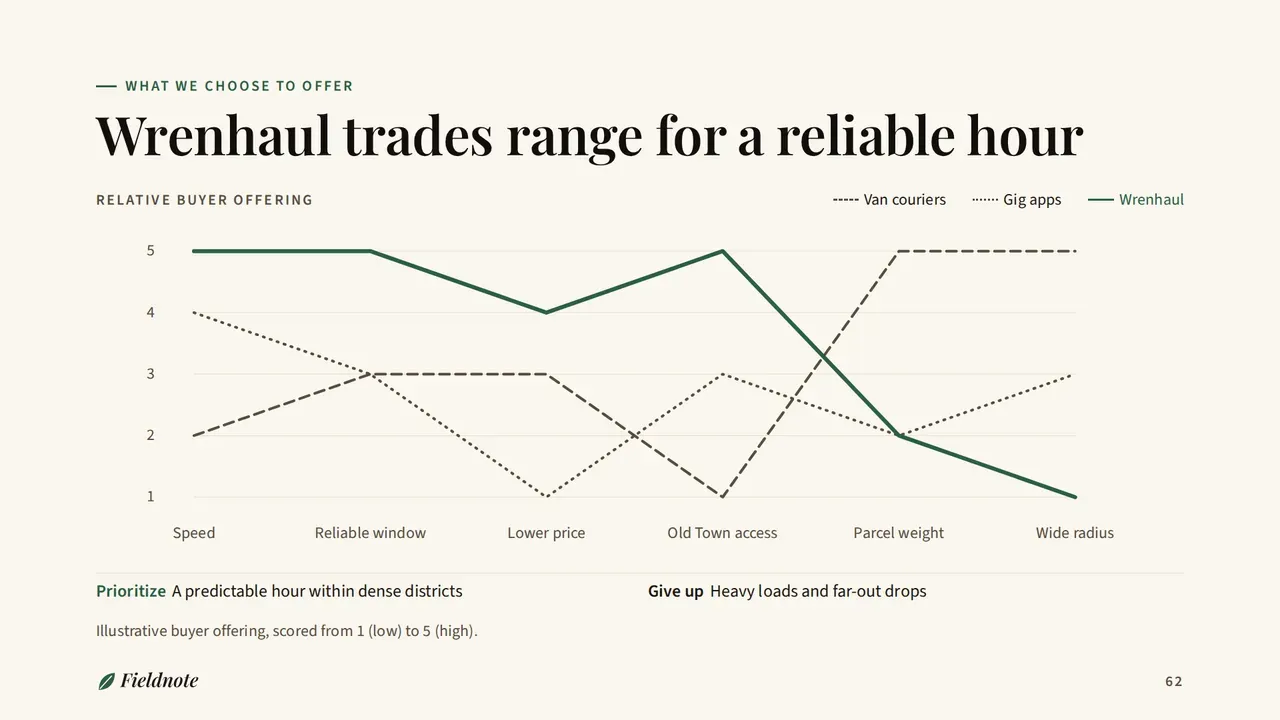
Wrenhaul invests in a reliable delivery window and accepts a smaller service area. Plot the competing offers against the same factors so the audience can see the cost of that choice.
Author the slide
Name four to six factors so a higher score has a clear meaning. For example, a higher score on Lower price represents a lower price. Score the two alternatives and your offer from 1 to 5, in factor order and using the same scale. Explain the scoring basis in the notes. Use emphasize and tradeoff to name the priority and what you give up. With reveal: true, the slide opens on the alternatives, then adds your offer and finally the tradeoff.
Example
---
layout: strategy-canvas
title: Wrenhaul trades range for a reliable hour
eyebrow: What we choose to offer
budget: 55s
reveal: true
factors: [Speed, Reliable window, Lower price, Old Town access, Parcel weight, Wide radius]
alternatives:
  - name: Van couriers
    levels: [2, 3, 3, 1, 5, 5]
  - name: Gig apps
    levels: [4, 3, 1, 3, 2, 3]
offer:
  name: Wrenhaul
  levels: [5, 5, 4, 5, 2, 1]
emphasize: A predictable hour within dense districts
tradeoff: Heavy loads and far-out drops
---

<Footnote>Illustrative buyer offering, scored from 1 (low) to 5 (high).</Footnote>

<Notes>
`strategy-canvas` compares the way alternative providers serve buying factors on the same qualitative scale. Van couriers can carry heavy parcels farther. Gig apps move quickly where there is someone nearby. [click] Wrenhaul puts its effort into a window shops can promise and a route riders can use inside the old town. [click] That leaves heavy and outlying drops to other services. A plan that tried to lead on every factor would take density away from the hour.
</Notes>
Slide 62 of the lookbook deckView on GitHub
Reference
- Frontmatter
layout: strategy-canvas- Surface
- the deck's default
- Title
- required, 76 characters at most
Plot two alternatives and one chosen offer across shared buyer factors, then state the emphasis and tradeoff.
Slots
| Slot | Takes | Budget | What goes in it |
|---|---|---|---|
body | — | Content outside every slot tag (in TSX, the default export). | |
<Footnote> | text | 24 words | A source or caveat on the bottom line. |
Frontmatter fields
| Field | Values | How to use it |
|---|---|---|
eyebrow | text | Write a few words of at most 40 characters, for example eyebrow: Budget committee, or leave it out. |
reveal | true false (default) | Show the alternative curves first, then the featured curve, then the strategic choices. |
chrome | true (default) false | |
factorsrequired | text | Give 4 to 6 ordered buyer factors up to 22 characters each, with a clear positive direction. |
alternativesrequired | text | Write 2 profiles with names up to 24 characters and one score 1–5 per factor, in order. |
offerrequired | text | Give a name up to 24 characters and one score 1–5 per factor, using the same assumptions. |
emphasizerequired | text | Describe the stronger offering in up to 64 characters. |
tradeoffrequired | text | Describe the sacrifice in up to 64 characters. |
Example
---
layout: strategy-canvas
title: Same-day lamp repair serves the neighborhood
reveal: true
factors:
  - Fast turnaround
  - Walk-in access
  - Rare parts
  - Wide coverage
  - Lower quote
  - Home pickup
alternatives:
  - name: Mail-in repair
    levels:
      - 2
      - 1
      - 5
      - 5
      - 4
      - 5
  - name: General workshop
    levels:
      - 3
      - 3
      - 4
      - 2
      - 3
      - 3
offer:
  name: Local lamp shop
  levels:
    - 5
    - 5
    - 2
    - 1
    - 5
    - 2
emphasize: Fast repairs within walking distance
tradeoff: Rare parts go to a specialist
---

<Footnote>Illustrative qualitative assessments.</Footnote>

<Notes>Read the alternatives. [click] Compare the local offer. [click] Explain its tradeoff.</Notes>
See the presentation patterns guide for related slides and their source files.