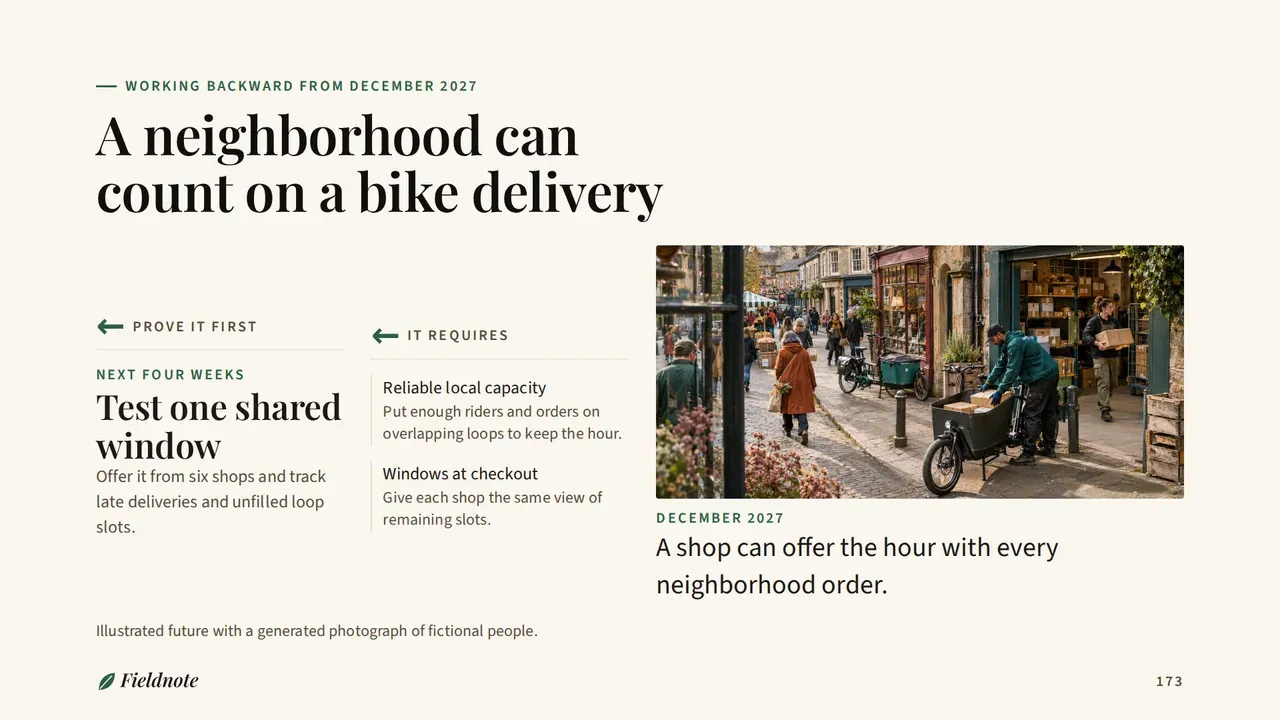
Start on the right with a shop that can offer the hour at checkout. Move left to the capabilities that promise requires, then to a four-week pilot that can test them.
Author the slide
Put the date, observable outcome and image in future. Name two capabilities and why the outcome depends on each. Finish with one bet containing a time window, an action and a test. Use reveal: true to uncover the chain in that order.
Example
---
layout: future-back
title: A neighborhood can count on a bike delivery
eyebrow: Working backward from December 2027
budget: 55s
reveal: true
future:
  when: December 2027
  outcome: A shop can offer the hour with every neighborhood order.
  image:
    src: ../assets/scenes/future-back-district.jpg
    alt: Cargo-bike riders serve independent shops across a sunny Old Town street.
    focal: center 56%
capabilities:
  - name: Reliable local capacity
    reason: Put enough riders and orders on overlapping loops to keep the hour.
  - name: Windows at checkout
    reason: Give each shop the same view of remaining slots.
bet:
  when: Next four weeks
  action: Test one shared window
  test: Offer it from six shops and track late deliveries and unfilled loop slots.
---

<Footnote>Illustrated future with a generated photograph of fictional people.</Footnote>

<Notes>
`future-back` begins with the customer’s world on the right and works back toward the next decision. Picture a December morning in Old Town: offering the hour is an ordinary checkout choice. [click] That requires both nearby rider capacity and the same view of available slots at each shop. [click] The immediate bet is a shared window across six shops. We will learn whether a group of shops can fill loops and still make the promise before rolling the window out across the district.
</Notes>
Slide 173 of the lookbook deckView on GitHub
Reference
- Frontmatter
layout: future-back- Surface
- the deck's default
- Title
- required, 70 characters at most
Start at a pictured desired future and trace backward to the capabilities and a near-term bet.
Slots
| Slot | Takes | Budget | What goes in it |
|---|---|---|---|
body | — | Content outside every slot tag (in TSX, the default export). | |
<Footnote> | text | 24 words | A source or caveat on the bottom line. |
Frontmatter fields
| Field | Values | How to use it |
|---|---|---|
eyebrow | text | Write a few words of at most 40 characters, for example eyebrow: Budget committee, or leave it out. |
reveal | true false (default) | Start at the illustrated outcome on the right. Reveal its capabilities to the left, then the immediate bet farther left. |
chrome | true (default) false | |
futurerequired | text | Give a horizon (when, 25 characters), outcome (76) and image ({ src, alt }, 160 alt characters) from a customer’s point of view. |
capabilitiesrequired | text | Write 2 prerequisites. Each takes a name up to 40 characters and a reason up to 78 explaining what it enables. |
betrequired | text | Write when (up to 24 characters), one action (up to 45) and the test that will change a decision (up to 100). |
Example
---
layout: future-back
title: A broken lamp should be working by dinner
reveal: true
future:
  image:
    src: "data:image/svg+xml,%3Csvg xmlns='http://www.w3.org/2000/svg' viewBox='0 0 640 360'%3E%3Cpath fill='%23e2eacb' d='M0 0h640v360H0z'/%3E%3Cpath fill='none' stroke='%233c4a62' stroke-width='7' stroke-linecap='round' stroke-linejoin='round' d='M65 286h512M421 170v101m-32 0h64m-93-103 32-74h57l31 74zM144 231q0-27 27-27h107q28 0 28 27v41H144zM171 206v-34m207-100-16-17m92 20 18-18'/%3E%3C/svg%3E"
    alt: A repaired lamp beside a sofa
  when: By next summer
  outcome: Neighbors collect repaired lamps on their way home.
capabilities:
  - name: Same-day triage
    reason: Identify the fix before the afternoon collection.
  - name: Common parts on hand
    reason: Complete common repairs without an extra visit.
bet:
  when: Next month
  action: Run four repair Saturdays
  test: Measure how many common repairs finish before 5 p.m.
---

<Notes>Start in the home. [click] Trace back to what the shop must be able to do. [click] Share the first test.</Notes>
See the presentation patterns guide for related slides and their source files.