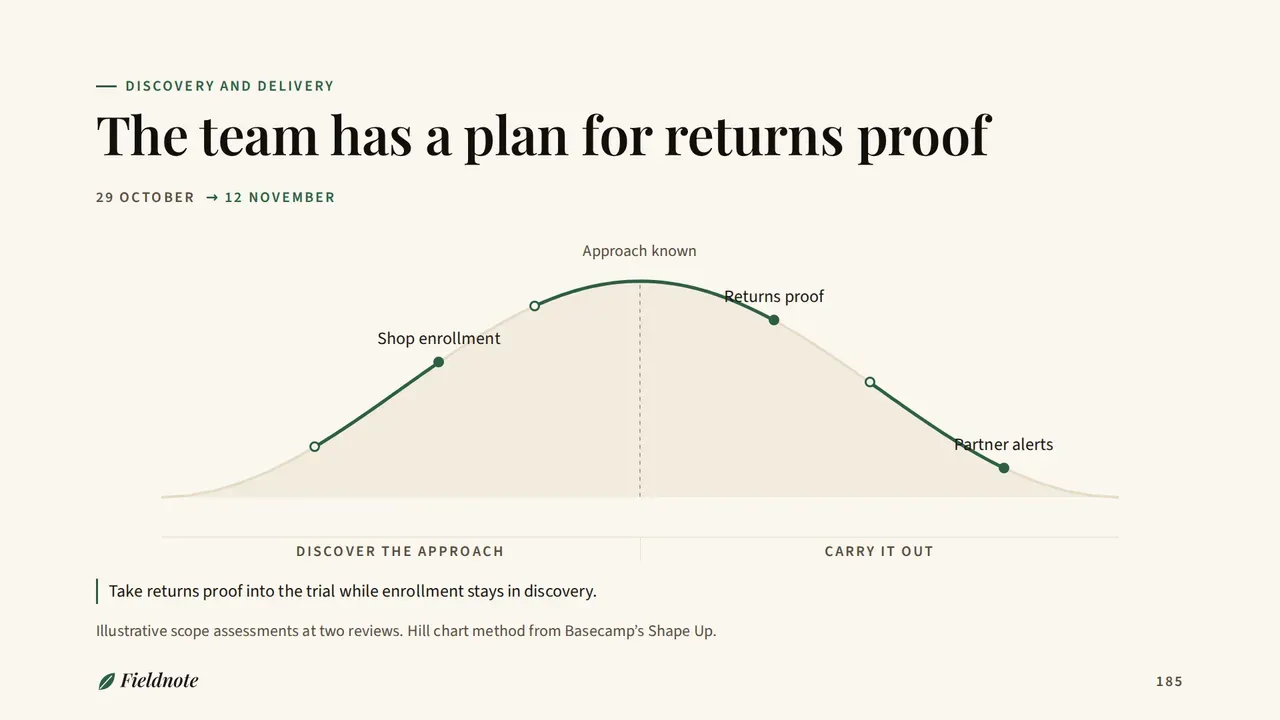
The team can start implementing returns proof while it is still figuring out how to enroll shops. Comparing two reviews on one hill makes that difference visible.
Author the slide
Name both review dates and give each of three scopes a previous and current position from 0 to 100. The rising side represents discovery, 50 means the approach is known, and the descending side represents execution. With reveal: true, the slide opens with the earlier positions and one advance reveals the current positions. Use takeaway to explain the decision the movement supports.
Example
---
layout: roadmap-hill
title: The team has a plan for returns proof
eyebrow: Discovery and delivery
budget: 50s
reveal: true
previous: 29 October
current: 12 November
scopes:
  - name: Shop enrollment
    previous: 16
    current: 29
  - name: Returns proof
    previous: 39
    current: 64
  - name: Partner alerts
    previous: 74
    current: 88
takeaway: Take returns proof into the trial while enrollment stays in discovery.
---

<Footnote>Illustrative scope assessments at two reviews. Hill chart method from Basecamp’s Shape Up.</Footnote>

<Notes>
`roadmap-hill` shows three scopes at two reviews. A scope climbs while we are finding the approach. Once we know what to build, it can descend through execution. [click] Returns proof crossed the crest when the team agreed who records the handover. Take that into a trial. Shop enrollment is still uphill because we need to see how a small shop adds returns without slowing its counter service.
</Notes>
Slide 185 of the lookbook deckView on GitHub
Reference
- Frontmatter
layout: roadmap-hill- Surface
- the deck's default
- Title
- required, 70 characters at most
Show where named scopes sit between discovering an approach and carrying it out.
Slots
| Slot | Takes | Budget | What goes in it |
|---|---|---|---|
body | — | Content outside every slot tag (in TSX, the default export). | |
<Footnote> | text | 24 words | A source or caveat on the bottom line. |
Frontmatter fields
| Field | Values | How to use it |
|---|---|---|
eyebrow | text | Write a few words of at most 40 characters, for example eyebrow: Budget committee, or leave it out. |
reveal | true false (default) | Show the earlier scope positions first and reveal their direction and new positions on the click. |
chrome | true (default) false | |
scopesrequired | text | Write 3 { name, previous, current } scopes, with names up to 25 characters. Positions 0–49 are discovering, 50 means the approach is known, and 51–100 are executing it. |
previousrequired | text | Label the earlier checkpoint, up to 22 characters. |
currentrequired | text | Label the current checkpoint, up to 22 characters. |
takeawayrequired | text | State what the movement means for the next decision, up to 92 characters. |
Example
---
layout: roadmap-hill
title: Route scanning has a workable approach
reveal: true
previous: 3 March
current: 17 March
scopes:
  - name: Shop enrollment
    previous: 18
    current: 30
  - name: Route scanning
    previous: 43
    current: 61
  - name: Label printing
    previous: 72
    current: 88
takeaway: Make the route scanner ready for the first trial.
---

<Notes>Read each scope on the earlier hill. [click] Route scanning has moved into delivery.</Notes>
See the presentation patterns guide for related slides and their source files.