The sources layout sets three to eight numbered references on one slide, so the audience can find the evidence behind a talk. Each reference has a title and, where you have them, an author, a publisher, a year and a web address. Use it at the close of a research talk or in an appendix.
Example
---
layout: sources
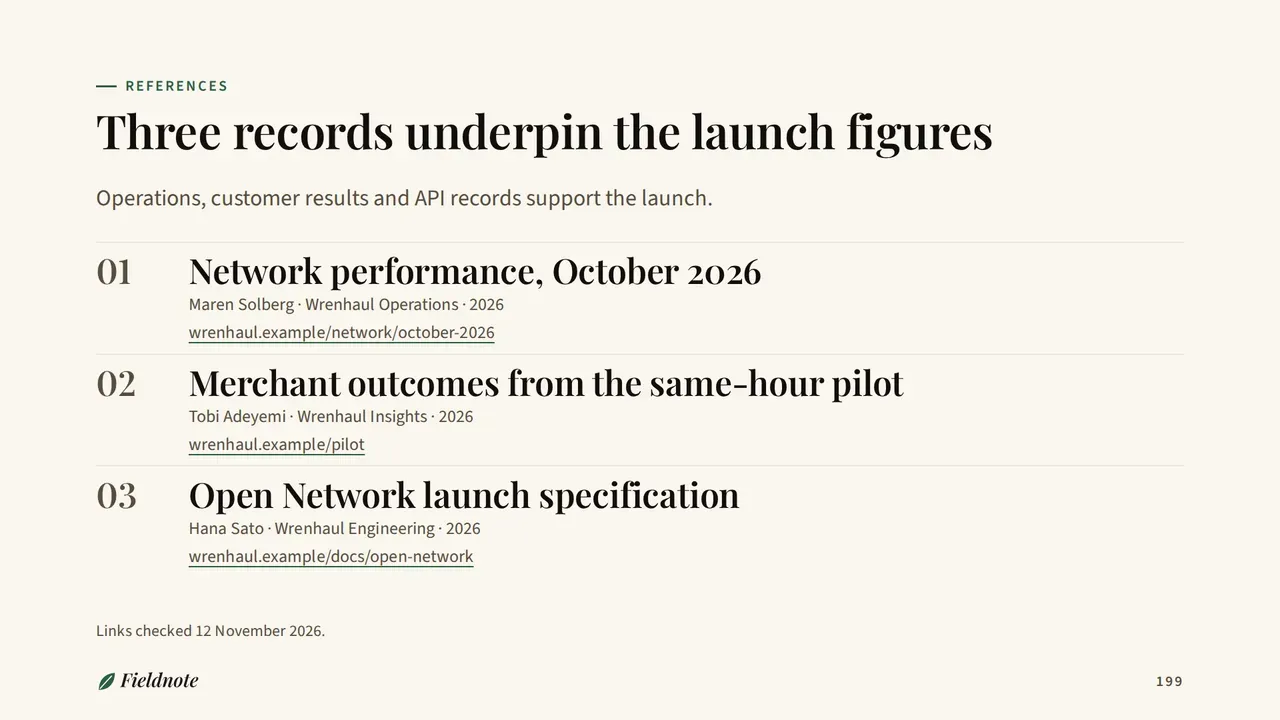
title: Three records underpin the launch figures
eyebrow: References
budget: 25s
sources:
  - title: Network performance, October 2026
    author: Maren Solberg
    publisher: Wrenhaul Operations
    year: "2026"
    url: https://wrenhaul.example/network/october-2026
  - title: Merchant outcomes from the same-hour pilot
    author: Tobi Adeyemi
    publisher: Wrenhaul Insights
    year: "2026"
    url: https://wrenhaul.example/pilot
  - title: Open Network launch specification
    author: Hana Sato
    publisher: Wrenhaul Engineering
    year: "2026"
    url: https://wrenhaul.example/docs/open-network
---

Operations, customer results and API records support the launch.

<Footnote>Links checked 12 November 2026.</Footnote>

<Notes>
`sources` with three complete references in one column; use it to leave the evidence behind a talk within reach.
The first record supports the 182,000 October drops and the €2.34 cost per drop. The second holds the merchant case studies. The third defines what opens today.
</Notes>
Slide 199 of the lookbook deckView on GitHub
The references are in sources:, in the order you cite them, and each becomes a numbered row (01, 02, …). author, publisher and year share one line, and url is the link under it, shown without https://. The body is one sentence on what the references support, and the <Footnote> holds the date the links were checked.
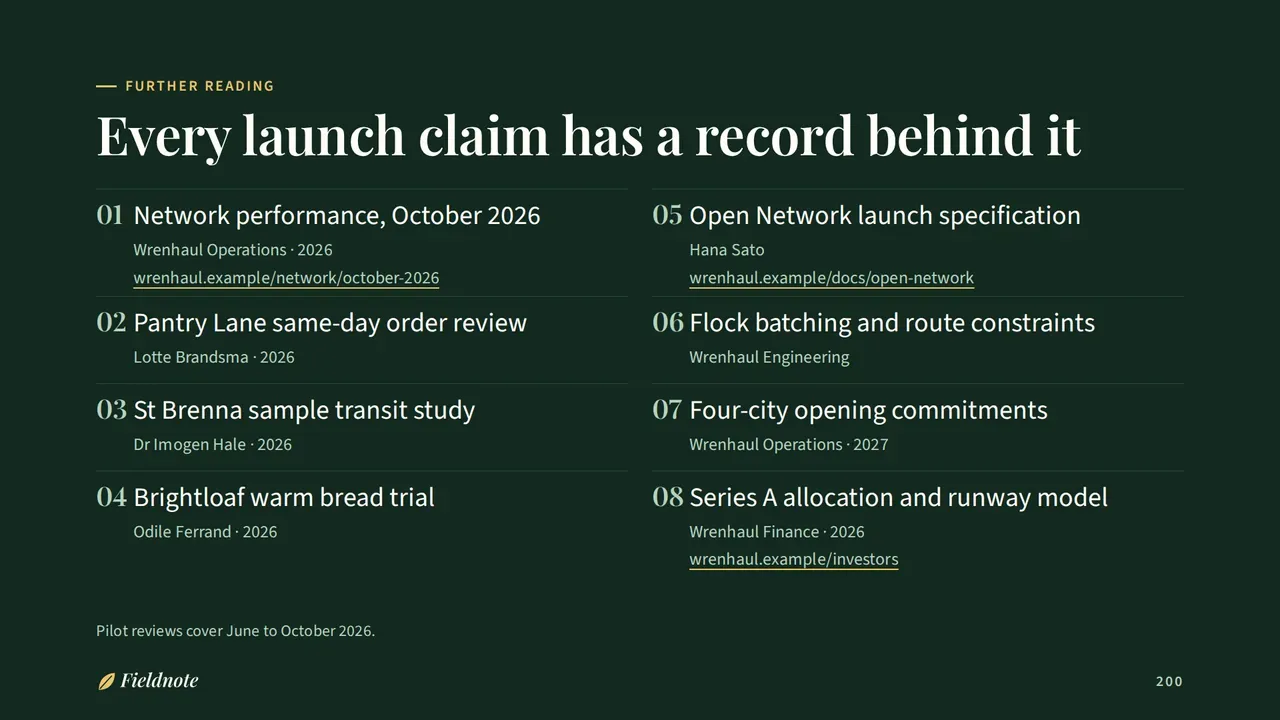
From five references on, the list runs down the left column and then down the right. An entry shows only the fields it has: here five of the eight have no address. The slide sets surface: inverse.
When to use it
- Three to eight references. For the source of one claim, put a
<Footnote>on the slide that makes it. For a longer bibliography, split it across slides. - Keep each field short. A
titletakes up to 80 characters, or 61 from five references on.authorandpublishertake up to 36, or 23 in two columns, andyearup to 9 (2026,2025–26,n.d.). The slide title takes up to 50 characters, the body 10 words and the footnote 16. - Give full addresses.
urlmust start withhttps://orhttp://and takes up to 240 characters. The slide shows a shorter label without the scheme or anything after?or#, cut at a slash, dot or hyphen past 64 characters (40 in two columns). The host is never cut, and the link opens the full address. - Everything shows at once. The layout has no
reveal. - Links to open now. For two or three links the audience should open during the talk, use
contentwith link cards; links shows how.
Reference
- Frontmatter
layout: sources- Surface
- the deck's default
- Title
- required, 50 characters at most
- PowerPoint
- title-only slide
Three to eight numbered references from sources:, each with a title and optional author, publisher, year and URL. Three or four references occupy one column; five to eight read down the left column, then down the right. Muted 01-style indexes identify citations; light lists scale up before their rows expand. Addresses are shown as short readable links while keeping their full destinations in the PDF. Use it at the close of a research talk or in an appendix so the audience can follow the evidence. Use default for a short list without citation fields, content for an explanation of the evidence, and a footnote on the relevant slide for the source of one claim. Use closing for one link with a QR code, and content with link cards for two or three links the audience should open now. All references show together, without reveal.
Slots
| Slot | Takes | Budget | What goes in it |
|---|---|---|---|
body | text | 10 words | One sentence on what the references support. Put citations in sources:. |
<Footnote> | text | 16 words | An access date or a caveat on the bottom line. |
Frontmatter fields
| Field | Values | How to use it |
|---|---|---|
eyebrow | text | Write a few words of at most 40 characters, for example eyebrow: Budget committee, or leave it out. |
sourcesrequired | text | List 3 to 8 sources in citation order, each with title (up to 80 characters, 61 for 5 to 8 sources) and optionally author (up to 36, 23 in two columns), publisher (up to 36, 23 in two columns), year (text, up to 9) and url (a full http: or https: address, up to 240 characters). Long addresses display in shortened form at a slash, dot or hyphen boundary (64 characters in one column, 40 in two); hosts are never cut and links open their full destination. |
chrome | true (default) false | Write chrome: false to hide the page number, logo and progress bar on this slide, or chrome: true to show them. |
Variants
- two columns —
sources[].title: 61 characters;sources[].author: 23 characters;sources[].publisher: 23 characters
Example
---
layout: sources
title: The canopy plan follows three local studies
eyebrow: References
sources:
  - title: Eastgate summer heat survey
    author: Dana Okafor
    publisher: Larkfield Council
    year: "2026"
    url: "https://larkfield.example/heat"
  - title: Holloway Road planting trial
    publisher: Urban Forestry Division
    year: "2025"
  - title: Street tree survival register
    year: "2026"
---

<Notes>
Keep these references available for questions about the canopy programme.
</Notes>
Common mistakes
-
A long title in two columns. With five or more references every title is held to 61 characters.
deck lintnames the limit and the variant:$ deck lint launch-review decks/launch-review/slides/src-dense.mdx error schema (src-dense): sources[0].title: The sources layout sets at most 61 characters here (two columns), got 74. Fix: Shorten it to the essentials; `deck layouts --json` lists the limits of each variant. launch-review: 1 error, 0 warnings. -
An address without a scheme.
url: wrenhaul.example/networkis aschemaerror: “Expected a web address that starts with https:// or http://”. Writehttps://wrenhaul.example/network. -
Nine references. The schema stops at eight: “sources: Expected at most 8 sources, got a list of 9 items.”
-
Adding
reveal: true. The finding is"reveal" is not a frontmatter field. -
Citations in the body.
content-budgetflags a body over 10 words. Put each citation insources:.